Monocouche explained
What Does One-Coat Monocouche Render Really Mean?
Monocouche is sold as a one-coat render, and people sometimes hear that as one thin layer applied in a morning. In practice it is a thick coat built in passes, left for hours to set, scraped, then protected for days. Knowing what one coat really covers helps you judge how long the job will take and what it can and cannot go over.

On this page
One material, several passes
One coat refers to the material, not the number of trips up the scaffold. A monocouche is a single factory-made, through-coloured cement render that replaces the separate base coat, finish and paint of a traditional render. It is still laid thick. K Rend's application instructions for its scraped one-coat renders describe about 18mm built in two passes, a first pass of 6-8mm followed by 12-14mm, with around 2mm scraped off after setting.
That thickness is what makes the colour work. If the scraped coat ends up too thin, K Rend warns that the background can show through as a shadow, which it calls ghosting. So a monocouche product carries real minimum thicknesses, and a quote that talks about one coat should still say what thickness the wall will finish at.
There is also a two-coat version. Where the wall is uneven, K Rend describes laying the scraped finish over its own base coat, brought to line and level first. The finish is still a single coloured material, but the wall gets two coats. Monocouche products should therefore be compared by their data sheets rather than by name, and when a silicone system is the alternative, compare the whole build-up of each, not just the colour of the final surface.

| Stage | Scraped monocouche | Silicone system |
|---|---|---|
| Base coat | Not needed on suitable blockwork | Cement base, nominal 4-6mm, mesh where needed |
| Wait before finish | None; finish is the coat | At least 14 days for fresh base |
| Primer | None | Colour-matched, 24 hours to dry |
| Finish | About 18mm laid, scraped to about 16mm | Thickness of largest grain, 1.5mm or 3mm |
| Colour | Through the whole coat | In the thin finish |
A hypothetical week on a monocouche wall
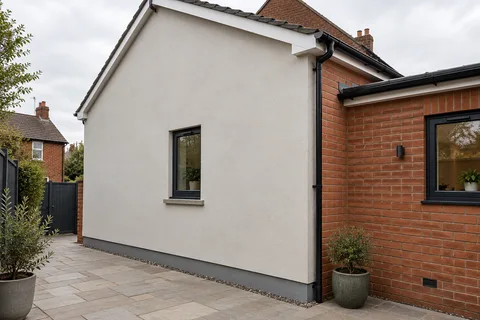
For example, picture a hypothetical rear extension in new blockwork, about the size of a single garage wall. On the first day the scaffold is checked, the windows and roof edge are sheeted against overspray, and beads go on at the base, the corners and the window reveals. If the blocks are very dry, they are dampened to control suction.
On the second day the render is sprayed or trowelled in its passes and levelled straight away with a straight edge. It is then left. K Rend gives a scraping window of anywhere between 4 and 36 hours, and says that in moderate weather the wall is typically scraped the day after. So on the third day, once a thumb no longer leaves a print but a thumbnail still marks it, the whole face is scraped lightly in tight circles and brushed down.
For the next two days the new render is kept out of rain and frost, as K Rend asks for the first 48 hours. If the forecast drops towards freezing, or rain is due on the day the wall would be sprayed, the work waits. One coat, then, is still most of a working week for one wall, and longer in a cold spell.
Reading the product, not the label
Ask for the exact product name. The monocouche service page explains the general system; the data sheet for the specific product tells you its thickness, temperature limits and the backgrounds it is designed for. K Rend's K Mono sheet, for instance, names moderate to low strength blockwork as its background and sets a 5-30°C window for application.
If the alternative on the table is a thin silicone finish, compare the two using the silicone guide. The silicone route has more stages and more waiting, but a finer texture and a wider colour range; monocouche is quicker on clean blockwork and needs no primer or paint.
Failure modes to know about
Most monocouche problems are visible ones. Blotchy shading comes from scraping some areas earlier or later than others, which K Rend links directly to darker and lighter shades. A ghostly pattern of blocks or joints showing through comes from render that ended up too thin. Lines across a wall come from stopping part-way across a panel at the end of a day rather than at a bead or corner.
A white haze in cold, damp weather is usually lime bloom, salts carried to the surface by water while the render is setting. K Rend describes it as temporary and not harmful to durability, and says it is best prevented by keeping setting render out of rain and away from water thrown off sills, copings and scaffold boards.
Cracking tends to follow the building: across the junction with an extension where no movement bead was fitted, above lintels, or at the corners of openings. And as with any render, a coat taken down over the DPC to the ground keeps the base wet. None of these is a fault of monocouche as such; they are faults of planning, thickness and timing that a one-coat label can hide.
What one coat cannot do
It cannot go over failing render. A thick cement coat applied over hollow render or loose dash adds weight to material that is already coming away. Painted surfaces are also a poor background, because the paint film stops the render bonding to the masonry.
It cannot easily be patched invisibly. K Rend notes that scraping earlier gives darker shades and later gives lighter ones, so a repair scraped on a different day rarely matches. A later colour change is possible, though: K Rend says its render can take masonry paint.
Use the Doncaster rendering homepage to connect the finish to the removal, repair and preparation work your walls need before any coat goes on.
Common questions
Does one coat mean the wall needs no preparation?
No. The background still has to be clean, sound and free of anything that would stop the render bonding, which on an old house can mean stripping, repointing and dubbing out before the first pass. On new blockwork the preparation may be little more than beads, masking and damping down. The product data sheet states what the background must be like; ask how your wall will be brought to that state.
Can monocouche be painted later?
Yes. Although it is chosen so that it does not need paint, K Rend says its render is a suitable surface for masonry paint if you want a different colour later. Once painted, though, the wall becomes a painted wall and will need repainting from then on, so it is a change worth thinking about.
See housing and planning information for Doncaster and nearby places, including the source and geography behind each figure.