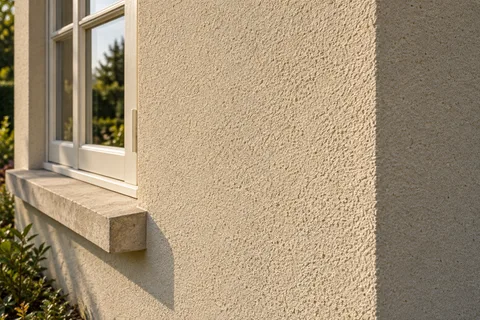
Monocouche render
Monocouche Rendering Doncaster: Through-Coloured Render
Monocouche is a coloured cement render designed to go on in a single coat and be scraped to texture, so the wall needs no painting. Single coat does not mean thin or quick. The material goes on thick, often in two passes, sets for hours before it is scraped, and depends on a sound, even background just as much as any other render.

On this page
What one coat actually means
K Rend's data sheet for its K Mono describes a cement-based, polymer-modified, through-coloured render. It is sprayed onto the prepared wall at 17-18mm, levelled straight away with a straight edge or spatula, left to set for 3-24 hours depending on the wall and the weather, then scraped to give the final texture. The minimum finished thickness after scraping is 15mm. K Rend's general instructions for its scraped finishes describe building about 18mm in two passes and scraping off about 2mm, and warn that going much thinner risks the background showing through as ghosting.
Because the pigment runs through the whole thickness, a chip or scuff shows the same colour rather than grey cement. That is the main reason people choose it over sand-and-cement and paint. The coat is one material, but it is still a substantial layer of render, and the wall behind it has to be ready to take it.
- Background Usually blockwork or brick; uneven or mixed walls may need a levelling coat.
- Beads and mesh Beads at corners, reveals and the base; mesh over junctions and lintels.
- Monocouche passes One through-coloured material, applied in passes to the specified thickness.
- Scraped surface Scraped once partly set, which removes the skin and leaves the texture.
Wall on the left, finish on the right. Not to scale: coats, thicknesses and primers follow the chosen manufacturer’s system and the condition of the wall.
Where it works and where it does not
It works best on clean, sound blockwork, which K Rend's sheet names as its intended background, and on brick that has been stripped and repaired. On an uneven stripped wall, a base coat may be needed to bring it to line first; K Rend's instructions describe a two-coat version where the scraped finish goes over its base coat at a minimum of 10-12mm.
It is not a coating for old painted render or firmly bonded dash; those either come off or suit a different system. Nor is it the right material for an older solid wall of soft brick or limestone, where SPAB's concerns about rigid cement-based coatings apply and lime render is the usual alternative.
Scraping, colour and joints
Timing the scrape is the skilled part. K Rend says the surface is ready when a thumb no longer leaves an impression and the aggregate scrapes away cleanly without sticking to the tool. It warns that scraping early gives a darker shade and scraping late a lighter one, so every area must be scraped at the same stage of readiness. On a large elevation the wall is planned in panels that end at beads, corners or openings, so that no area is half-finished at the end of a day.
Quoins and window reveals can be finished smooth with a float for contrast. Ashlar lines can be cut into the scraped surface, but K Rend's data sheet asks for at least 15mm of coloured render to remain behind each cut. Bell-cast, corner and stop beads set the edges before the first pass goes on.
Check the background is sound and even; repair or dub out where needed.
Fix bell-cast, corner and stop beads and mask glazing against overspray.
Spray or trowel the render to full thickness and level it straight away.
Leave it to set until a thumb leaves no mark.
Scrape each panel to texture at the same stage of readiness, then brush down.
Protect the new work from rain and frost for the first two days.
Weather, lime bloom and later repairs
K Rend's data sheet rules out application below 5°C or above 30°C, when frost is forecast within 24 hours, in damp conditions, or on elevations in direct sun, and asks for the wall itself to be above 3°C. Cold, damp weather also raises the risk of lime bloom, a pale bloom of salts drawn to the surface. K Rend describes it as temporary, but asks that downpipes, sills and scaffold boards are not allowed to throw water onto setting render.
Patches in monocouche are hard to hide, because colour depends on the batch and on when the patch was scraped. If you later want a different colour, K Rend says its render is a suitable surface for masonry paint, which is a respray rather than a re-render.
Common questions
Can monocouche go over the existing render?
Rarely as a straight overcoat. Old render that is sound and well bonded is usually better recoloured; render that sounds hollow has to come off. Monocouche is designed for clean masonry or a suitable base coat, so the survey of the old finish decides the route.
See housing and planning information for Doncaster and nearby places, including the source and geography behind each figure.