Render repairs
Render Repairs Doncaster: Cracks and Hollow Patches
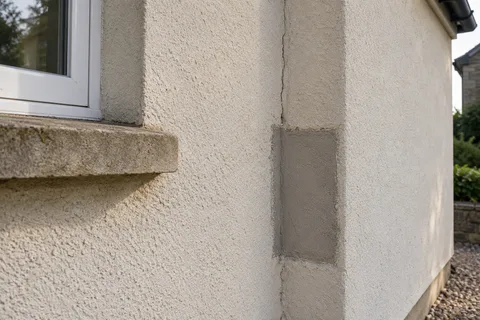
A render repair replaces a damaged area rather than the whole wall: a crack that lets rain in, a patch that has blown away from the brick, a broken edge round a window or a strip at the base that stays damp. A good repair finds how far the damage really goes, fixes the cause where it can, and rebuilds the patch in coats that suit the wall.

On this page
Finding how far the damage goes
The visible crack is rarely the whole story. Tapping the render with a knuckle or the handle of a tool finds hollow areas, where the coat has lost its bond and sounds drummy; SPAB uses exactly that distinction, between sound render and hollow-sounding patches, when deciding what to remove. The hollow area is marked out with chalk, and it is often larger than the crack that drew attention to it.
Then look at why it happened. Fine crazing across the surface is usually shrinkage in the top coat. A crack running from the corner of a window, or straight up a wall, may follow movement in the masonry. Staining below a sill points to a sill without a working drip, and a blown strip at ground level often means the render runs over the DPC. K Rend's design guidance covers each of these: sills and copings that project with a drip, gutters and downpipes that keep water off the wall, and render that stops above the DPC.
- Map the damage Tapping finds hollow areas; cracks and their likely cause are noted.
- Cut back Failed render is cut out to a sound edge, usually squared off.
- Fix the cause Leaking gutters, sills without drips or render below the DPC are dealt with.
- Rebuild in coats Using a material compatible with the surrounding render and masonry.
- Blend the finish Texture is matched; colour may need a coating over the wider area.
The usual order of work. The survey and the chosen products decide the actual steps.
How a patch is made
The damaged render is cut back to firm material with straight, clean edges, and anything loose behind it is removed. The masonry is repaired, joints repointed where needed, and the area dampened if it is very absorbent. The patch is then rebuilt in the same number of coats as the original, each keyed and left to firm before the next, so the repair finishes flush with the surrounding surface. For K Rend's base coats, that means a light key and 24 hours before the next coat.
The repair material has to suit the wall. On an older solid wall with lime render, a cement patch is harder and less permeable than its surroundings and can push the problem next door. SPAB notes that mixes with a hydraulic set can be used for patching where an old render can only be partly removed, which is a lime-based approach, not a cement one.
Tap-test and mark the hollow and cracked areas.
Find and fix the cause: sill drip, gutter, downpipe or render over the DPC.
Cut back to sound render with clean edges and clear loose material.
Repair the masonry beneath and dampen absorbent areas.
Rebuild the patch coat by coat to match the original thickness.
Finish to match the texture, then recolour to a natural break if needed.
Why patches show
Even a well-made patch can be visible. New render is a different age and often a slightly different shade, and texture is hard to copy exactly. Through-coloured monocouche is the hardest to hide, because K Rend's guidance shows that shade changes with the time the surface is scraped. Painted render is the easiest: the repair is painted with the rest of the elevation, ideally to a corner or downpipe rather than a square around the patch. Matching stones on old pebbledash is often impossible, so a dashed wall with many repairs may be better recoated as a whole, which is the respray route.
When a repair is not enough
If tapping finds hollow areas across most of an elevation, patching just moves the next failure along; re-rendering the wall is the honest answer. Cracks that keep returning in the same place, or that are wide or stepped through the brickwork, suggest movement that a surveyor or structural engineer should look at before any render goes back. Fix the water first, too: a patch under a leaking gutter will fail again.
Common questions
Can a small crack just be filled?
A fine surface crack in sound render can be filled and painted. If the render around it sounds hollow, or water has been getting in behind, filling only hides the problem; the hollow area needs cutting out and rebuilding.
How soon can a repaired patch be painted or finished?
When the repair material says it is ready, not when it looks dry. Each coat of a cement patch needs time to firm before the next, and finishes have their own rules: K Rend, for instance, asks for its base coats to be left at least 14 days before its silicone finish goes on. Painting too early can trap moisture and leave the patch darker than the wall around it.
See housing and planning information for Doncaster and nearby places, including the source and geography behind each figure.